

Moments of loss are always heavy on the heart, and many people feel confused about what to say or how to respond. That’s why the topic What to Say When Someone Dies in Islam is so important, as it guides us to comforting words that align with Islamic teachings.
What to Say When Someone Dies in Islam
Losing someone dear is always painful, and many people feel unsure about what to say during such moments.
In Islam, offering condolences is not just about polite words—it is a form of spiritual support rooted in faith.
When you hear of a Muslim’s death, the first phrase to say is:
“إِنَّا لِلَّهِ وَإِنَّا إِلَيْهِ رَاجِعُونَ” Indeed, we belong to Allah, and to Him we shall return.
Well-structured Quran courses online connect Quranic guidance with real-life situations, helping Muslims respond to death with faith, patience, and compassion.
The Islamic View of Death and Acceptance
Islam teaches that death is not the end, but a transition from this world to the Barzakh. It is a divine decree for every soul, and believers are encouraged to respond with patience rather than objection.
While grief is natural, Islam discourages prolonged despair, reminding us that a believing soul is under Allah’s mercy. Remembering death strengthens faith and motivates good deeds.
Common Islamic Condolence Phrases and Their Meanings
In Islamic condolences, words carry deep meaning. They are not merely polite expressions, but reminders of faith, mercy, and the hereafter. Most condolence phrases are Arabic supplications that offer comfort to the grieving family and mercy for the deceased. These phrases can be spoken in person, over the phone, or written in messages.
“Inna Lillahi Wa Inna Ilayhi Raji‘oon”, “إِنَّا لِلَّهِ وَإِنَّا إِلَيْهِ رَاجِعُونَ”, Indeed, we belong to Allah, and to Him we shall return.
This is the most fundamental Islamic phrase said upon hearing news of a death. It reflects the belief that life is temporary and that every soul will return to Allah.
Many non-Arabic speakers also learn this phrase by heart as a sign of respect when a Muslim passes away.
Supplications for Mercy and Forgiveness
After the initial condolences, the most important act in Islam is supplicating for the deceased, as it is the greatest benefit they receive once their deeds have come to an end.
- “اللَّهُمَّ اغْفِرْ لَهُ وَارْحَمْهُ”, O Allah, forgive him and have mercy on him. This short supplication asks Allah to forgive the deceased and surround them with mercy.
- “اللَّهُمَّ اغْفِرْ لَهُ وَارْحَمْهُ وَتَجَاوَزْ عَنْ سَيِّئَاتِهِ”, O Allah, forgive him, have mercy on him, and pardon his shortcomings.
Read about: How to get forgiveness from Allah
Prayers for Admission to Paradise
Praying for admission to paradise is one of the most beneficial acts after death.
- “اللَّهُمَّ أَدْخِلْهُ الْجَنَّةَ”, O Allah, admit him to Paradise.
- “اللَّهُمَّ اجْعَلْ لَهُ مَنْزِلَةً عَالِيَةً فِي الْجَنَّةِ”, O Allah, grant him a high place in Paradise.
These phrases express hope in Allah’s reward and belief in eternal life after death.
Prayers for Patience for the Bereaved
Condolences also address the living:
- “رَبَّنَا يَرْزُقُكُمُ الصَّبْرَ”, May Allah grant you patience.
- “رَبَّنَا يَقَوِّيكُمْ وَيَرْبِطْ عَلَى قُلُوبِكُمْ”, May Allah give you strength and comfort your hearts.
Patience (sabr) is a highly valued virtue in Islam, and these phrases acknowledge grief while encouraging spiritual strength.
How to Support the Deceased’s Family
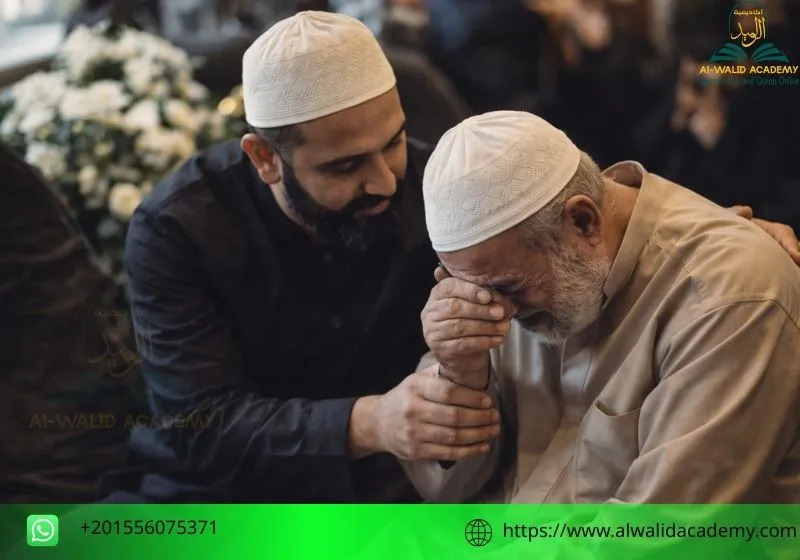
When someone loses a loved one, actions speak louder than words. Supporting the deceased’s family doesn’t have to be elaborate; sometimes your presence or a simple call can ease their pain and give them reassurance. Islam provides specific deeds and etiquette to show support properly.
Read about: What Did Muhammad Said Before He Died
Practical Actions to Support the Deceased’s Family
Practical support is one of the most important forms of condolence in Islam. Visiting the family, attending the funeral, or even sitting quietly with them are all meaningful ways to show solidarity and mercy.
- Attend the funeral prayer and burial if possible. The Prophet ﷺ said: “مَنْ صَلَّى عَلَى الْمَيِّتِ فَلَهُ قِيرَاطٌ” Whoever prays over the deceased will receive a reward of one Qirat.
- If you cannot attend, call or sit with them, even silently. Your presence alone makes a difference.
Recommended Words of Comfort in Islam
Saying the right words at the right time can ease grief and increase patience. There are phrases from the Quran and Sunnah that comfort the family and strengthen their faith.
- “إِنَّ لِلَّهِ مَا أَخَذَ وَلَهُ مَا أَعْطَى وَكُلُّ شَيْءٍ عِنْدَهُ بِأَجَلٍ مُسَمًّى، فَاصْبِرْ وَاحْتَسِبْ”
Indeed, to Allah belongs what He takes, and to Him belongs what He gives. Everything has a fixed term with Him, so be patient and seek reward. - Common condolence phrases: “أَعْظَمَ اللَّهُ أَجْرَكُمْ، أَحْسَنَ عَزَاءَكُمْ، وَغَفَرَ لَهُ شُهِيدَهُ”, May Allah magnify your reward, grant you the best consolation, and forgive the deceased.
Or:
“رَحِمَهُ اللهُ وَغَفَرَ لَهُ وَأَسْكَنَهُ الْجَنَّةَ” May Allah have mercy on him, forgive him, and grant him Paradise. - Supplication for the family: “اللَّهُمَّ أَجِرْهُمْ فِيْ مُصِيبَتِهِمْ وَاخْلُفْ لَهُمْ خَيْرًا مِنْهَا”, O Allah, reward them for their loss and replace it with something better.
Or:
“صَبْرًا جَمِيْلًا وَرَحْمَةً مِنْ عِنْدِ اللَّهِ” Patience and mercy from Allah.
Learn more about: Death verses in the Quran
Practical Support and Ongoing Charity
Practical support goes beyond words; it helps the family focus on prayer and worship while also benefiting the deceased through continuous reward.
- Bring halal prepared food: cooked meals, fruits, or sweets.
- Assist with household shopping or chores.
- Ongoing charity: donations in the deceased’s name to a mosque, school, or feeding the poor provide continuous reward for the deceased.
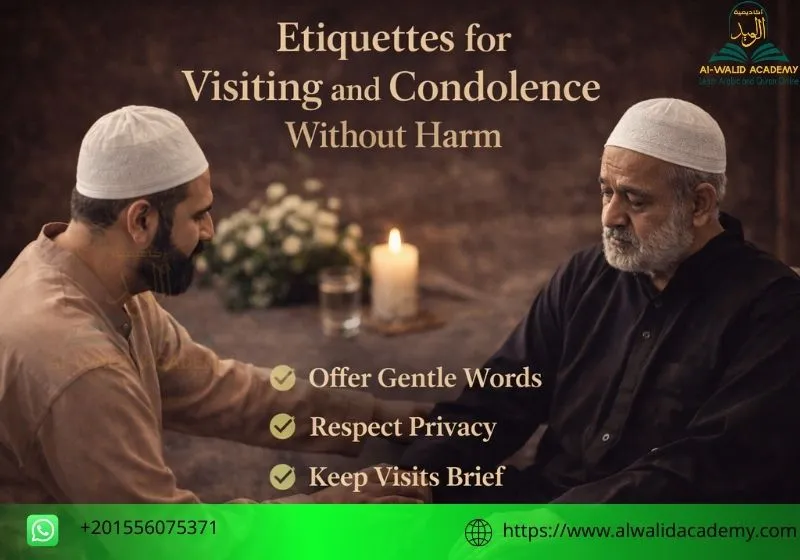
Etiquettes for Visiting and Condolence Without Harm
Visiting the family of the deceased has etiquette that maintains respect and comfort for them.
- Dress modestly: simple clothing for men, hija,b and loose covering for women.
- Follow the family’s lead in rituals; if unsure, politely ask or say:
“يَسِّرْ اللَّهُ أَمْرَكُمْ” May Allah make your matters easy. - Sometimes listening is better than speaking too much.
- Respect their religious and cultural customs.
How to Express Sympathy Without Causing Pain
True sympathy eases the family’s grief without adding more pain. It focuses on positivity and sincere support.
- Focus on the positive: reward, Paradise, and continuous prayers.
- Attend condolences for three days or more if possible.
- Be sincere and concise; comforting silence can sometimes be better than words.
- Continue praying and giving charity in the deceased’s name:
“اللَّهُمَّ اغْفِرْ لهم وارحمهم، وصبر أهله وأجّرهم، واجعل قبورهم روضة من رياض الجنة”, O Allah, forgive them, have mercy on them, grant patience to their family, and make their graves a garden from the gardens of Paradise. - May Allah reward the patient and grant continuous blessings to the deceased and their family.
Read about: Dua for Making Things Easy
What to Say If You Are Not Muslim
If you are not Muslim and want to console a Muslim friend or neighbor, you can do so with respectful and sincere words that comfort them without contradicting their beliefs. The key is to express empathy in a kind way, showing your humanity while respecting Islamic culture.
Respectful Condolences Muslims Appreciate
Even if you are not Muslim, there are phrases familiar in Islamic culture that the family will appreciate and that provide comfort without directly praying for the deceased. The most important thing is sincerity and good intentions.
- “أحسن الله عزاءكم” – May Allah give you the best consolation.
- “جبر الله مصيبتكم” – May Allah ease your grief.
- “عوّضكم الله خيراً” – May Allah replace your loss with something better.
- “صبر جميل” – Patience in this trial.
- “عظّم الله أجركم” – May Allah magnify your reward.
Neutral Words That Are Appropriate
If you are not Muslim or are unsure about the family’s beliefs, use neutral words that focus on supporting the living, expressing sympathy, and encouraging patience, without mentioning Paradise or religious concepts.
- “أنا آسف جداً لفقدانكم، وأدعو الله يعطيكم القوة والصبر” – I’m very sorry for your loss, and I pray Allah gives you strength and patience.
- “تعازيّ الحارّة، أفكر فيكم في هذا الوقت الصعب” – My condolences, thinking of you in this difficult time.
- “أتمنى لكم الصبر والسلوان” – Wishing you patience and solace.
- “واقف معكم في هذا المصاب” – Standing with you during this loss.
Practical Actions to Support the Family
Words alone are not enough; there are practical actions you can take as a non-Muslim to show sympathy and support the family, helping them focus on prayer and reflection.
- Attend the funeral if invited (usually men).
- Dress modestly and respect local customs.
- Sit quietly and listen more than you speak.
- Help with halal food, shopping, or light household chores to ease the family’s burden.
- Friendship and respect are most important: May Allah have mercy on the deceased, grant patience to the family, and bless relationships between Muslims and non-Muslims.
Learn Quran, Arabic, and Islamic Studies with certified teachers in fun, interactive, and personalized sessions. Join thousands of students around the world and begin your path today!
Words to Avoid When Offering Condolences in Islam
In Islam, offering condolences is not about repeating routine phrases. It is meant to bring comfort through patience, sincere prayer, and reminding the bereaved of Allah’s mercy and reward.
That is why certain words should be avoided, even if they are said with good intentions, because they may cause pain or conflict with Islamic beliefs.
Phrases That Conflict With Islamic Beliefs
Some expressions are commonly used but are religiously inappropriate or theologically incorrect in Islam, and it is better to avoid them:
- Using phrases like “the forgiven one” or “the late (guaranteed mercy),” Muslims are not permitted to judge the final state of the deceased. Instead, it is better to say: “May Allah forgive him/her” or “We ask Allah to grant him/her mercy.”
- Saying “Praise be to Allah who is not praised for hardship itself.”
This wording is inaccurate in Islamic teachings. A Muslim praises Allah in all circumstances, but not for the calamity itself. - Saying “O Allah, reverse the decree.”
Divine decree cannot be reversed. What is encouraged instead is supplication for patience and reward. - Making definite claims about the deceased’s destiny, such as: “He is surely in Paradise” or “Allah took him because He loved him.” Judgment belongs to Allah alone, and it is safer to limit one’s words to sincere du‘a’.
- Sending flowers to funerals, while this is common in many Western cultures, it is not a widespread Islamic custom and may even be disliked in some communities. More appropriate alternatives include:
- Providing halal food.
- Giving charity on behalf of the deceased.
If unsure, asking a close family member or friend is considered respectful, not awkward.
Well-Meaning Words That May Be Hurtful
Some phrases may sound comforting, but can unintentionally deepen the pain of the bereaved:
- “They died for a reason”, “At least they did not suffer long.”, Such statements minimize the loss and may make the grieving person feel that their pain is being dismissed.
- “Do not cry” or “Move on with your life.” Grief has no fixed timeline, and everyone processes loss differently.
- “I understand how you feel.” This should be used carefully, as no two experiences of grief are the same.
Islam teaches that true empathy is sometimes best expressed through simple, sincere gestures:
- Saying “I am here for you”.
- Offering quiet presence without forcing conversation.
- Making a heartfelt supplication (du‘a’).
The Right Words That Bring Comfort
These are words recommended in Islam because they combine faith, compassion, and emotional sensitivity, helping to soothe the hearts of the bereaved without causing harm.
From the Sunnah of the Prophet:
“Indeed, to Allah belongs what He has taken, and to Him belongs what He has given, and everything with Him has an appointed time. So be patient and seek reward.”
Commonly accepted and comforting phrases include:
- “May Allah increase your reward, bring peace to your heart, and comfort you during this time.”
- “May Allah cover him/her with His mercy and pardon all shortcomings.”
- “O Allah, reward them in their calamity and replace it with something better.”
Duas to Say After Hearing About a Death

In Islam, the first response after hearing about someone’s death is not long speeches or confusion, but sincere supplication.
Short authentic duas from the Sunnah carry great reward for the one who says them and mercy for the deceased in the grave.
Though simple, these words bring calm to the heart and help accept the decree of Allah with faith.
Read also about: Dua Khatam Al Quran
Short Authentic Duas From the Sunnah
- The immediate response Muslims say when hearing about a death is remembering that we belong to Allah and will return to Him. Allahumma’jurni fi museebati wa’khluf li khayran minha.” This phrase reminds us that we belong to Allah and will return to Him, encouraging patience and reward.
- The best condolence for the family of the deceased: “Indeed, to Allah belongs what He has taken, and to Him belongs what He has given, and everything with Him has an appointed time. So be patient and seek reward.” These were the words of the Prophet himself, combining faith in divine decree with patience.
- A simple supplication for the deceased: “Allahumma’ghfir lahu wa’rhamhu.” Or: “Our Lord, forgive him and those who preceded him in faith.” Short supplications that can be said at any time.
- What to say when visiting the grave: “Peace be upon you, O inhabitants of the graves, among the believers and Muslims. And indeed, we will join you, if Allah wills.” A supplication filled with mercy and a reminder of the Hereafter.
Repeating these duas regularly, along with seeking forgiveness and giving ongoing charity, allows continuous reward to reach the deceased by Allah’s permission.
How Muslims Express Condolences Beyond Words
In Islam, condolences are not limited to spoken words. True sympathy is shown through actions. The Prophet ﷺ attended funerals and supported grieving families, teaching us that standing beside others in times of loss is an act of worship.
Visiting, Helping, and Being Present
- Attending the funeral and burial: Performing the funeral prayer carries immense reward, and participating in the burial strengthens solidarity. If attendance is not possible, a sincere call or visit within the first three days is deeply meaningful.
- Practical help: Among the best forms of condolence are:
- Sending prepared halal food.
- Helping with shopping or transportation.
- Assisting with household tasks.
These actions ease the burden on the family and allow them to focus on prayer.
- Silent presence: Sometimes quiet companionship is more comforting than words. Sitting calmly and listening can bring great relief.
- Ongoing charity on behalf of the deceased: Donating to a mosque, school, feeding the poor, or any charitable cause in the deceased’s name is among the greatest benefits that continue after death.
How Long Condolences Are Offered in Islam
Condolences in Islam are not just words—they are a prophetic practice to comfort the bereaved and pray for the deceased. The duration of offering condolences is not strictly fixed, but there are practical guidelines for when to start and how long to continue.
Condolences should begin as soon as the news of the death is heard, even before the burial if grief is intense. There is no strict end time, but generally, three days are sufficient to calm the family’s hearts before grief returns.
Cultural Practices vs Islamic Guidance
Islamic Guidance: No hadith strictly sets three days, but the majority of scholars (Hanafi, Maliki, Shafi’i, Hanbali) consider three days recommended. Some scholars, like Al-Nawawi and Ibn Muflih, allow it to continue as long as grief remains, while Abu Hanifa says it should not continue after the burial.
Cultural Practices: In Saudi Arabia and the Gulf, three days is standard. In Egypt and the Levant, it can extend to 7 or even 40 days. The key is that condolences should not become idle gatherings, and prayers should continue at all times.
Begin condolences immediately upon hearing the news, attend the first three days, and afterward, if grief remains or you are absent, focus on prayer and ongoing charity rather than prolonging gatherings that may reopen sorrow.
Etiquette of Condolences in Islam
Prophet Muhammad ﷺ taught that condolences should be short and sincere, aiming to remind people of God and patience, not to prolong grief or speeches.
Keep Words Simple and Sincere
After the first three days, continue seeking forgiveness and reciting the Quran for the deceased. May Allah forgive them and teach us the proper etiquette of offering condolences, but
- Use short and authentic phrases, such as:
- “May Allah magnify your reward, perfect your consolation, and forgive the deceased.”
- Simple words that remind us of patience and Allah’s mercy are enough—there is no need for long or emotional speeches.
- Sincerity over length:
- Say it with a faithful heart and genuine tears.
- Sometimes, comforting silence is better than too much talking.
- Avoid loud wailing or exclamations like “Oh my God!”
- Dress modestly: men on the right, women on the left.
- Additional Etiquette:
- Helping the family by bringing ready halal food eases their burden during difficult days.
- Assist with shopping, transporting relatives, or household chores.
- Donate in the deceased’s name (mosque, school, feeding the poor).
- On social media, post “Inna lillahi wa inna ilayhi raji’un” + a general prayer, avoid pictures of the deceased.
Learn the Correct Duas and Condolences with Al-Walid Academy
If you want to know what to say when someone passes away and learn the correct supplications that bring comfort to the deceased and their family, Al-Walid Academy offers courses that teach you the Prophetic practices for every situation—whether giving condolences or making dua after hearing the news of a death.
What Al-Walid Academy Can Offer You:
- Courses on Recommended Duas After Death: Learn authentic Sunnah prayers that bring reward to both you and the deceased.
- Understanding Sunnah and Condolence Etiquette: How to offer condolences in a proper, comforting way without adding to the grief.
- Practical Training on Daily Duas: How to repeat supplications correctly and gain ongoing reward for yourself and the deceased.
- Personalized Guidance for Every Student: Qualified teachers guide you through the steps of supplication and Sunnah with practical examples.
- Flexible Online Classes: Suitable for all ages, whether you are a beginner or want to improve your knowledge of Sunnah and Duas.
Start now with Al-Walid Academy and learn all the essential Duas and Sunnah practices related to offering condolences after death. Register for an online course today and get practical guidance to apply it in your daily life with ease.
Conclusion
Condolences in Islam are not just words spoken during grief; they are acts of worship rooted in supplication, patience, and mercy. This article explained what to say when someone dies in Islam and how to choose the right words that comfort the family without causing additional pain or conflicting with Islamic beliefs.
From saying “Inna lillahi wa inna ilayhi raji‘oon” to making prayers for mercy and forgiveness, observing condolence etiquette and duration, and offering practical support through presence, help, and ongoing charity—these are all Sunnah-based practices that bring comfort to hearts and remind us of the Hereafter.
Simple, sincere words and heartfelt dua are the essence of proper Islamic condolences and a means of earning great reward from Allah.
FAQs
Can condolences be sent by text message in Islam?
Yes, sending condolences by text message is acceptable, especially if you cannot visit or call. What matters most is that the message is sincere, respectful, and shows genuine care rather than feeling like a formality.
Is it okay to stay silent when offering condolences?
Yes. A quiet presence can sometimes be more comforting than words. Sitting with someone or simply being there without speaking much can bring more comfort than prepared phrases.
What is the safest phrase to say if you’re unsure about Islamic wording?
If you are unsure about religious expressions, choose simple, human words that express support and compassion. Such phrases are always appropriate and well-received.
Can women offer condolences to men in Islam?
Yes, offering condolences is not limited by gender. What matters is maintaining respect and appropriate boundaries, whether the condolences are given in person or through a message.
Is it appropriate to share condolences on social media?
It can be appropriate, but with sensitivity. Keep messages short and respectful, and avoid sharing personal details, as some families prefer privacy over public posts.
Do Muslims expect repeated condolences after the funeral?
Not necessarily. One sincere condolence is enough, but checking in later with a kind word or prayer—without reopening the pain—is often appreciated.
What if you meet the family long after the death?
It is perfectly acceptable to offer condolences even after time has passed. A brief, gentle expression of sympathy still conveys care and remembrance.
Can children offer condolences in Islam?
Yes. When done in a simple, age-appropriate way, it helps children learn empathy and kindness. They are not expected to use formal or lengthy expressions.